Most Common McDVoice Complaints: The McDVoice survey has become one of the most important customer feedback tools used by McDonald’s across the United States. Every day, thousands of customers visit McDonald’s restaurants, place mobile orders, use drive-thru lanes, and redeem rewards through the app. After their visit, many of them are invited to complete the McDonald’s survey and share their honest experiences.
What makes McDVoice customer feedback valuable is that it provides direct insight into what customers actually experience rather than what companies assume they experience. Whether someone receives excellent service or encounters frustrating issues, the survey offers an opportunity to report it. According to the official McDVoice survey platform, McDonald’s actively collects customer opinions to evaluate restaurant performance and improve service quality.
When analyzing McDonald’s customer complaints, several recurring themes appear repeatedly. Customers frequently mention slow service, order mistakes, food quality concerns, app glitches, and reward redemption issues. These complaints offer a revealing look into what modern fast-food customers expect and where restaurants occasionally fall short. This article explores the most common McDVoice complaints in America, why they happen, and what they reveal about customer expectations in today’s fast-food environment.
Why McDonald’s Uses The McDVoice Survey?
Customer feedback has become one of the most valuable business tools in the restaurant industry. McDonald’s serves millions of customers annually across thousands of U.S. locations, making it nearly impossible for corporate teams to personally monitor every guest experience. The McDonald’s Survey helps bridge that gap by allowing customers to report both positive and negative experiences directly.
The survey covers multiple aspects of the restaurant experience. Customers are often asked about order accuracy, food freshness, employee friendliness, restaurant cleanliness, speed of service, and overall satisfaction. These responses help identify trends that individual restaurant managers can address before they become larger operational problems.
The survey also benefits customers because it provides a formal channel for sharing concerns. Unlike social media complaints that may get lost in a crowded feed, McDVoice feedback goes into a structured system specifically designed to measure customer satisfaction. The incentive offered through survey validation codes encourages participation while generating valuable data that helps improve the overall McDonald’s customer experience.
What Customers Commonly Mention in McDVoice Feedback?
Slow Drive-Thru Service
One of the most frequently reported McDVoice complaints involves slow drive-thru service. Fast food customers choose drive-thrus because they expect convenience and speed. When a visit takes significantly longer than expected, frustration builds quickly.
Recent customer complaints shared publicly have highlighted waits exceeding 20 to 40 minutes in some situations, even when using mobile ordering features. Customers often express disappointment when they order ahead through the app but still find themselves parked and waiting for extended periods.
Drive-thru delays can occur for many reasons. Staffing shortages, high demand periods, equipment issues, and complex custom orders all contribute to slower service. While customers understand occasional delays, repeated slow experiences often become a major factor in negative survey responses.
Incorrect Orders
Among all McDonald’s customer complaints, order accuracy remains one of the most common concerns. Few things are more frustrating than discovering a missing burger, incorrect drink, or forgotten side item after leaving the restaurant.
Order mistakes are particularly problematic for drive-thru and delivery customers because correcting the issue often requires another trip or lengthy customer service interaction. Families ordering multiple meals are especially likely to notice inaccuracies because larger orders naturally create more opportunities for mistakes.
The issue becomes even more noticeable during peak hours when employees are processing a high volume of transactions. Although many restaurants emphasize accuracy checks, customers frequently mention incorrect orders in survey responses because accuracy directly impacts satisfaction.
Cold Food Complaints
Food freshness remains a major component of McDonald’s food quality complaints. Customers expect burgers, fries, and breakfast items to be served hot and freshly prepared.
When food arrives cold or lukewarm, customers often perceive it as old or improperly handled. French fries receive particular attention because they are highly sensitive to temperature and freshness. A fresh batch of fries can dramatically improve a dining experience, while cold fries can lead to immediate dissatisfaction.
Customers who use delivery services may face additional challenges because transportation time can affect food temperature. Nevertheless, survey feedback often focuses on the condition of the food at the moment it is received, making temperature-related complaints a consistent topic in McDVoice responses.
Long Wait Times
Although related to drive-thru performance, general wait times represent a broader category of complaints. Customers frequently report delays at front counters, curbside pickup spots, and mobile order stations.
Modern consumers have increasingly high expectations regarding convenience. Fast-food restaurants are expected to deliver meals quickly, making even moderate delays feel significant. Social media complaints often highlight situations where customers feel their time was not respected.
Long wait times can affect customer perceptions of the entire restaurant operation. Even if the food quality is acceptable, excessive delays may cause customers to rate their experience negatively.
Restaurant Cleanliness Issues
Restaurant cleanliness remains a surprisingly important factor in customer satisfaction surveys. Customers pay close attention to dining areas, restrooms, beverage stations, and parking lots.
Cleanliness serves as a visual indicator of overall restaurant management. If customers observe dirty tables, overflowing trash bins, or poorly maintained restrooms, they may question the cleanliness of food preparation areas as well.
Many McDVoice responses include comments about maintenance standards because customers associate cleanliness with professionalism and food safety. A clean environment creates confidence, while visible cleanliness issues often trigger negative feedback.
Poor Customer Service Experiences
Human interaction continues to play a major role in the McDonald’s customer experience. Customers frequently mention employee attitudes, communication skills, and professionalism when completing surveys.
Positive service can often compensate for minor operational issues. Conversely, rude interactions may overshadow an otherwise satisfactory visit. Customers commonly report concerns related to inattentive employees, lack of courtesy, poor communication, or unhelpful responses when addressing problems.
In a competitive fast-food market, customer service remains one of the strongest factors influencing brand loyalty. As a result, service complaints appear frequently in McDVoice survey responses.
Mobile App and Ordering Problems
Technology has transformed how customers interact with McDonald’s, but it has also created new sources of frustration. McDonald’s mobile app problems frequently appear in customer feedback.
Common complaints include app crashes, failed payments, missing reward points, location detection issues, and difficulties placing orders. Some customers also report situations where orders were submitted successfully but encountered delays or confusion during pickup.
Because digital ordering has become increasingly popular, technical issues can significantly affect customer satisfaction. Customers expect digital tools to simplify their experience rather than create additional obstacles.
Missing Items in Takeout Orders
Takeout and delivery orders generate another recurring complaint category: missing items. Customers often discover absent sauces, drinks, desserts, or side dishes after arriving home.
Unlike dine-in customers who can immediately request corrections, takeout customers face greater inconvenience when items are missing. This inconvenience amplifies frustration and increases the likelihood of negative survey feedback.
Many restaurants now use checklist systems to reduce packing errors, but missing items remain one of the most common issues reported in fast-food customer surveys.
Inconsistent Food Quality
Consistency is one of the defining promises of major fast-food brands. Customers expect their favorite menu items to taste similar regardless of location.
When food quality varies significantly between visits, customers notice. Some McDVoice responses mention burgers that appear overcooked, fries that seem stale, or beverages that do not meet expectations. Customer reviews and broader restaurant studies have also highlighted concerns regarding texture, freshness, and preparation consistency in certain menu items.
Maintaining consistency across thousands of locations is challenging, making food quality variation a recurring topic in customer feedback.
Reward and Promotion Frustrations
The popularity of digital rewards programs has introduced a new category of customer complaints. McDonald’s rewards issues often involve expired offers, unavailable promotions, technical redemption failures, or confusion about eligibility requirements.
Customers increasingly rely on rewards programs to maximize value. When promotional offers do not work as expected, frustration can be substantial. Some customers report difficulties redeeming earned rewards, while others express dissatisfaction when advertised promotions are unavailable at specific locations.
Because loyalty programs directly affect perceived value, reward-related complaints continue to appear regularly in McDVoice survey responses.
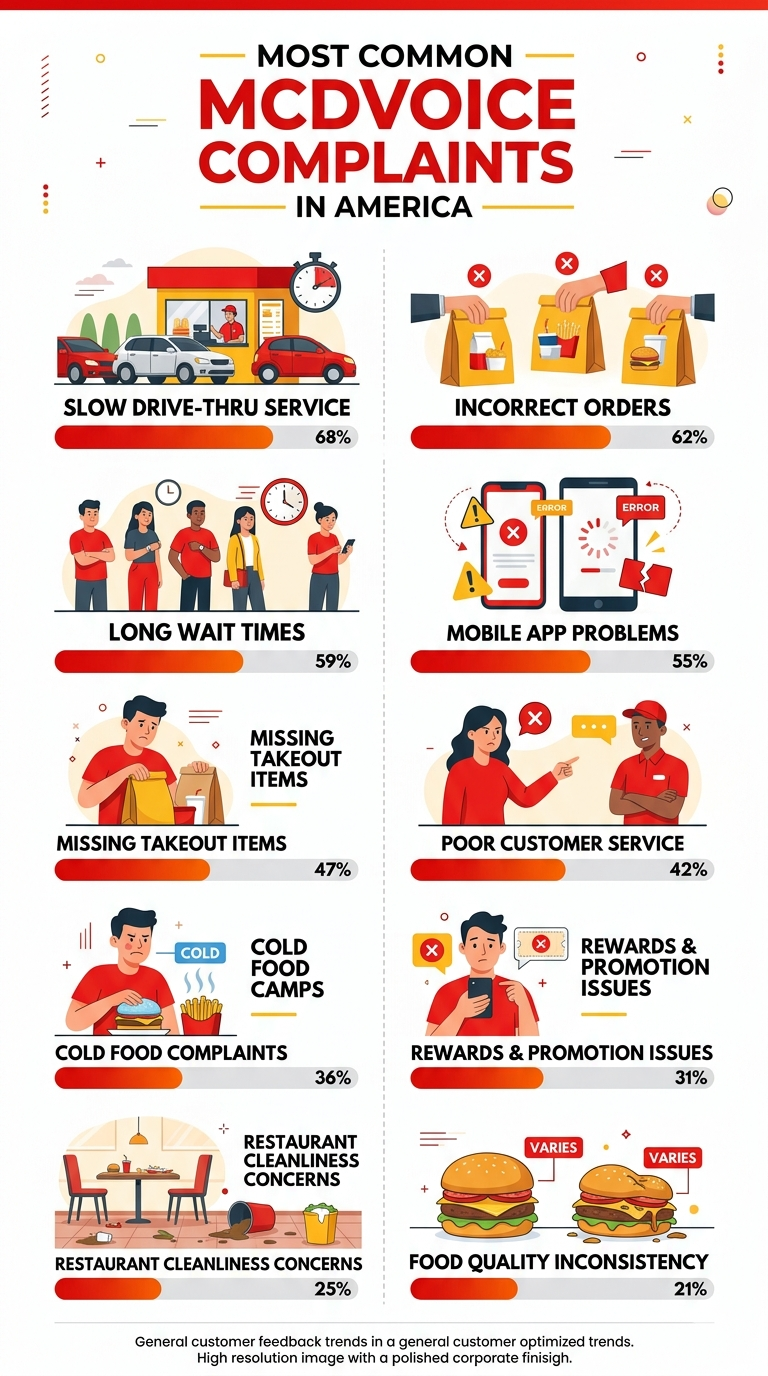
Which Complaints Appear Most Frequently Across America?
While individual experiences vary by location, several complaint categories consistently appear more often than others. Based on publicly available customer discussions, social media feedback, and survey-related reporting, the most frequently mentioned concerns include:
| Complaint Category | Frequency Level |
|---|---|
| Slow Drive-Thru Service | Very High |
| Incorrect Orders | Very High |
| Long Wait Times | Very High |
| Mobile App Issues | High |
| Missing Items | High |
| Customer Service Problems | High |
| Cold Food | Moderate to High |
| Rewards Issues | Moderate |
| Cleanliness Concerns | Moderate |
| Food Quality Variability | Moderate |
The dominance of speed-related complaints reflects changing consumer expectations. Today’s customers expect convenience, accuracy, and efficiency simultaneously. Any failure in those areas tends to generate immediate feedback.
How McDonald’s Responds to Customer Complaints?
McDonald’s actively encourages customers to report concerns through official feedback channels. The company uses survey responses, customer service contacts, and social media interactions to identify operational issues and investigate specific complaints.
When customers raise concerns publicly, McDonald’s frequently responds by requesting additional details, including restaurant locations, order information, and contact information for follow-up investigations. Public responses often indicate a willingness to review individual cases and address service failures.
Restaurant managers also review survey results to monitor performance trends. Locations with recurring complaints may receive additional training, operational adjustments, or management attention aimed at improving customer satisfaction scores.
How Customers Can Submit More Effective Feedback?
Not all customer feedback is equally useful. Specific, detailed comments provide far more value than general frustration.
Customers can improve the effectiveness of their feedback by including:
- Visit date and time
- Restaurant location
- Order details
- Description of the issue
- Employee interactions involved
- Desired resolution
Constructive feedback increases the likelihood that restaurant managers can identify root causes and implement meaningful improvements. Instead of simply stating that service was poor, explaining exactly what happened provides actionable information.
The most effective McDVoice customer feedback combines honesty with specificity. Detailed responses help managers understand not only what went wrong but also how similar issues can be prevented in the future.
What These Complaints Reveal About Customer Expectations?
The most common McDVoice complaints reveal an important truth about modern consumers. Customers no longer evaluate restaurants solely on food quality. They assess the entire experience.
Speed, convenience, technology, cleanliness, accuracy, and service all influence satisfaction. Customers expect mobile apps to function flawlessly, drive-thrus to move quickly, rewards programs to work reliably, and employees to provide friendly service.
These expectations continue to rise as technology advances and competition intensifies. Fast-food customers compare experiences not only against competitors but also against their own previous visits. Consistency has become just as important as quality.
The complaints reported through McDVoice demonstrate that customers value reliability above all else. They want restaurants to deliver on promises consistently, whether those promises involve fast service, accurate orders, or convenient digital ordering.
Key Takeaways
- Slow drive-thru service remains one of the most common McDVoice complaints.
- Incorrect orders continue to frustrate customers nationwide.
- Long wait times significantly impact customer satisfaction.
- Mobile app problems are increasingly common as digital ordering grows.
- Missing takeout items remain a major source of negative feedback.
- Customer service quality strongly influences survey ratings.
- Food freshness and consistency continue to shape customer perceptions.
- Rewards and promotion issues affect loyalty program satisfaction.
Frequently Asked Questions (FAQs)
1. What is the McDVoice Survey?
The McDVoice survey is McDonald’s official customer satisfaction survey that allows customers to provide feedback about their restaurant experience and receive a validation code for eligible offers.
2. What are the most common McDVoice complaints in America?
The most common complaints include slow drive-thru service, incorrect orders, long wait times, mobile app problems, missing items, and customer service issues.
3. Does McDonald’s read McDVoice survey responses?
Yes. Survey responses are collected and reviewed to evaluate customer satisfaction and identify areas for improvement.
4. Why do customers complain about McDonald’s drive-thru service?
Customers typically complain when wait times become excessive, orders are delayed, or mobile orders do not speed up the pickup process as expected.
5. Are mobile app issues common in McDonald’s feedback?
Yes. Customers frequently report problems related to rewards, order processing, payment failures, and app functionality.
6. Can negative McDVoice feedback still earn rewards?
Yes. According to the official survey information, eligibility for survey rewards is not dependent on whether feedback is positive or negative.
7. How can customers make their feedback more useful?
Customers should provide detailed information including location, order details, timing, and a clear explanation of the issue they experienced.
Conclusion
The most common McDVoice complaints in America paint a clear picture of what customers value most when visiting McDonald’s. Speed, accuracy, cleanliness, service quality, food freshness, and reliable technology consistently shape customer satisfaction levels. While many complaints focus on operational challenges such as long waits and order mistakes, they ultimately reflect broader expectations for convenience and consistency.
For customers, the McDVoice survey provides a meaningful opportunity to influence future improvements. For McDonald’s, these survey responses offer valuable insight into real-world restaurant performance. The ongoing conversation between customers and the company helps identify weaknesses, strengthen service standards, and improve the overall dining experience across thousands of locations nationwide.